
Regenerative Ag Doesn’t Scale (And That’s Okay!)
How to make a garment without losing your proverbial shirt

People are obsessed with scaling regenerative agriculture.
And listen, I get it. After all, if you care about regen ag for any reason— because you’d like to eat healthy food, you’re an environmentalist, an “impact” investor, or simply someone eager to continue occupying a livable planet, then getting the biggest farms and ranches, who are operating at the biggest scales, to make the transition to regenerative production would be huge. It’s literally just more efficient. I mean, how much time will we spend trying to convince fifty 100-cow dairies to transition, when we could convince just one 5,000 cow dairy to do it, and potentially have the same impact.
But the biggest point of resistance among farms and ranches operating at that scale is that, “my farm is too big, these regen ag practices just don’t fit right.” (I feel like there’s a condom joke in there somewhere…). Hence our obsession with finding some version of regenerative ag that will work at the scale of America’s biggest operations.
Now, I’ve talked a lot about our unhealthy obsession with “scalable solutions” here, but I want to address it today specifically in the context of regen ag. Because I’d argue that if your “regen ag program” is scalable– if it can be applied in a standardized way across a vast landscape– there’s a good chance it’s not regenerative at all.
This is why, I’d argue, it’s essentially impossible to run a 5,000+ cow dairy, a 10,000 acre corn/soybean operation, or a 500 acre processing tomato farm regeneratively. This is, in short, because truly regenerative systems can’t be standardized, which means they threaten the very thing that the very biggest farms depend on most. In other words, real regen ag fucks with economies of scale.
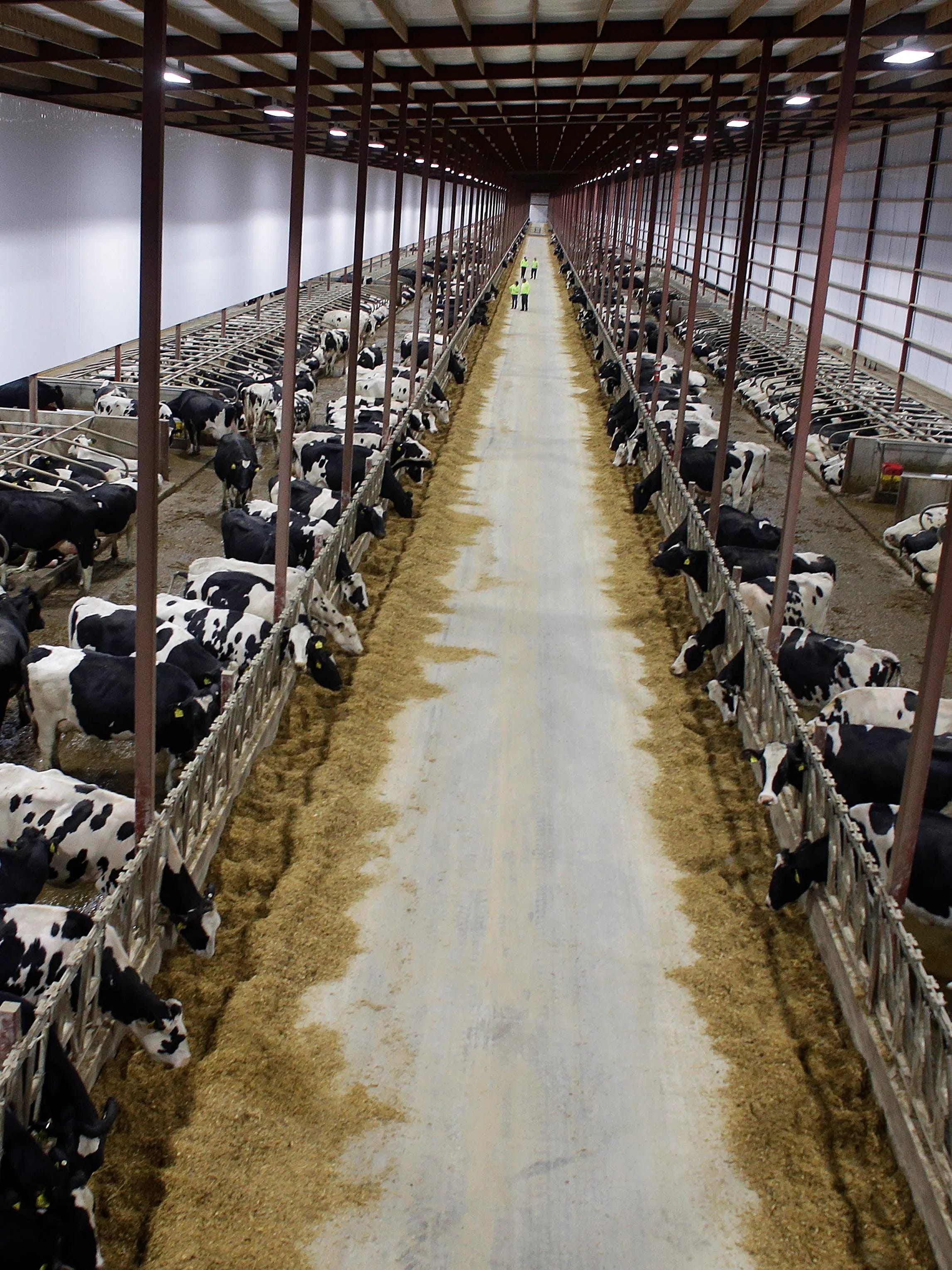
Economies of Scale: The U.S. Ag Commandment
Let’s start with the brass tax: The American economy runs on economies of scale. Every mega-company you can think of, from McDonalds to Walmart to United Healthcare, got huge largely by obsessively dialing in their returns to scale. This has been long the organizing principle of our economy, everyone who’s made money in the last century knows that capturing economies of scale is how it’s done.
But what exactly are economies of scale? Essentially, it’s the idea that the more you are able to distribute capital costs over a large quantity of production, the more your cost per unit will go down. This allows you, the producer, to gain more profit as the gap between the cost of production and the price widens.
Capturing economies of scale can look different in different situations, but there are commonalities across cases. First, create large and centralized production hubs (maybe a giga-factory, a corporate headquarters, or a “superstore”) and then increase the amount of stuff/services you create/sell until there’s not a second of downtime, a drop of redundancy, or a whisper of “waste” anywhere in your system. The result; a cost of production that rapidly approaches 0.
But what does this actually look like in, say, agriculture? Here’s an example: I’m a farmer with 100 acres of corn. To farm that 100 acres, I need inputs like seeds and fertilizer, which together cost $1,000 a year, but I also need a tractor for field work and a combine for harvesting, which each cost $10,000 per year. That means that my cost per acre of production is $210. Now, if I could get access to a few hundred more acres (grow the size of my “factory”), bringing my farm up to 500 acres total, that would be a game-changer for my unit economics. I’d still have to pay $1,000/hundred acres for seed and fertilizer, but I could use the same tractor or combine for essentially no extra cost. So my new cost per acre would be only $50, because I’ve spread the cost of the tractor and combine over more units of production. That means that if I can more or less maintain productivity, I could more than triple my profit per acre.
This is a simplified example, but it is, more of less, exactly how America’s farmers capture economies of scale today. Like businesses throughout the economy, they are increasingly being pressured, by rising input costs (inflation!) and stagnant or declining prices to dig further and further into the economies of scale hole, because the rule in American agriculture has for decades been to focus on “the bottom line,” AKA aggressively and myopically drive the cost of production towards zero, by adding acres, buying ever bigger equipment, and reaching fanatically towards higher and higher and higher yields. Each of these actions should, if executed at peak efficiency, decrease the cost of every bushel of corn, ton of almonds, or head of cattle raised.
This is the modern refinement of for Ag Secretary Earl Butz’s “get big or get out” command, and for many commercial-scale farmers today, this is how they compete. The enormous scale they achieve also allows a tiny number of people to work thousands of acres and raise tens of thousands of animals, with the help of a ton of capital, huge equipment, advanced genetics and chemistry, and little else. And though there are risks, the returns to this scale can be epic. When you’re able to plant and harvest not 500 acres with a single tractor and combine, but 5,000 acres, resulting in millions of bushels* of grain, for example, you can sell those bushels even at rather low prices and still make money. Margins can be thin in conventional agriculture, but that doesn’t mean there aren’t boatloads of cash to be made for a savvy farmer who can drive their unit cost as close to zero as possible.
But for those who want to see farms become more regenerative, especially the biggest farms that control the most acres and could have the biggest impacts, the problem is that transitioning to regenerative farming does not lead to more returns to scale. If anything, regenerative tends to undermine economies of scale.
No Volume Discount on Regenerative Ag
To explain why regenerative ag does this, I have to start by explaining what I mean by regenerative ag, which requires gesturing to the standard disclaimer; that there is no standard or enforceable definition of regenerative agriculture (yada yada yada).
But! For people who are serious about regenerative, I think most would say the essence of regen ag are captured in the healthy soil principles. And there are several that are both common and straightforward:
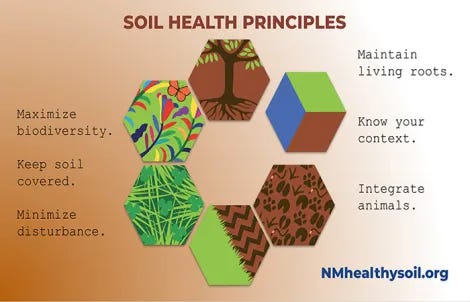
Now, I’m not trying to argue that practices that further some of these principles offer no economies of scale, some certainly do. Planting cover crops on 5,000 acres, and thus making progress on “maintaining living roots,” may well offer lower unit economics than planting cover crops of on 100 acres (at the very least, I think, you can get a volume discount on cover crop seed). The unit cost of your strip-till or no-till machine, which will help you pursue the “minimizing disturbance” principle, will certainly decrease as you use it on a greater number of acres. In short, many of the individual practices associated with healthy soil and regenerative ag can offer some returns to scale.
But ask any farmer, soil scientist, or regen-curious agronomist, and they’ll tell you that there is a tremendous difference between adopting regenerative practices and actually seeing regenerative results.
I got the chance to see the contrast between practices and outcomes first hand recently. I was visiting a 5,000 cow “regenerative” dairy, and it was a surreal experience. I’m no soil expert, but I’ve been around enough farms to know when soil’s alive and well, and when it’s being strip-mined for bushels. But never before had I been lectured by a farmer about their regenerative program while I was literally standing on compacted, parched, beige dust that was actively blowing away in a 10 mph breeze. The cognitive dissonance on display, to be bragging about “bringing the soil back to life” while the corpse of it was blowing up my nose, was something else.
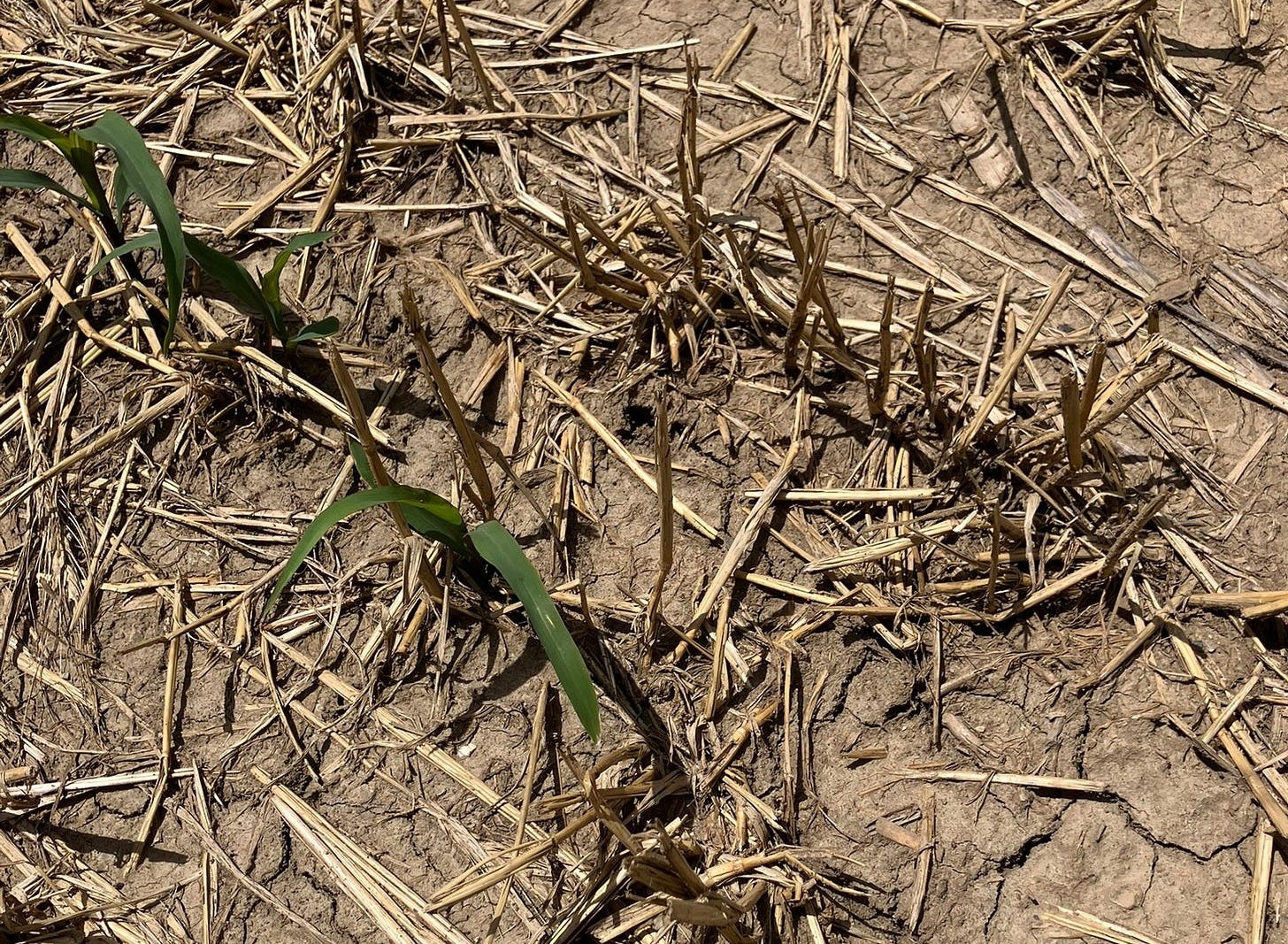
In the farm’s defense, they are using regenerative practices! They are planting cover crops, they are reducing tillage, they’re using manure from the cows as a soil amendment. And yet, the dirt was lifeless, and the outcomes seemed to be a long way from what we might ideally think of as “regenerative.” So what gives?
I’d guess that a big part of what’s happening on this farm is that the most important soil health principle is not being followed. “Know your context” might seem like the most wishy-washy of the six principles, but in creating regenerative outcomes, it’s arguably the most important. Knowing your context is about understanding things like local climate conditions, hydrology, biodiversity, and soil characteristics, because “though the soil health principles are universal, how they are implemented in your operation will depend on your specific context.” Knowing your context then, is about recognizing that a farm is not a factory, where each unit (be that an acre, a tree, a cow, or something else) is identical to the next and thus can be treated in a standard, generalized way. Knowing your context requires putting eyes on your operation, walking fields regularly, observing animals, plants, weather, the flow of water, and other conditions as often as possible. In other words, it’s about having an intimate understanding of every part of your farm, so that you aren’t tempted to paint with the broad brush (with ideas like, “cover crop all of it”) but can instead carefully tailor decisions, goals, and practices to the needs and conditions of individual parts of the farm.
Knowing your context is a hard principle to master, but I don’t think that’s why it’s the one people most often skip.
I think farmers ignore it because “knowing your context” defies economies of scale. This happens because knowing and responding to unique conditions requires that farmers de-standardize their operations and stop treating every acre/animal/plant as a generic unit identical to any other. This is antithetical to economies of scale, which require standardization.
We can see why by returning to our example farm. If we want to distribute the price of the tractor and combine across the 500 acres versus the 100, and realize our economies of scale, I have to first actually be able to use that equipment on those acres. That means what I plant on those new acres has to be the same (or at least, very very similar) to what I’d planted before. But if I don’t standardize my production, say, by planting corn on the first 250, but planted oats on the next 250, then though I’ll be able to use the same tractor on all 500 acres (tractors aren't crop specific), I will need to buy a new oat harvester, another $10,000 expense on top of the combine. This raises my per acre production cost from $50/acre to $70/acre, on both my corn and oat acres. In other words, by increasing the diversity of my crop mix (another regenerative practice!), and thus reducing the standardization of my production, I’ve had to forgo some significant benefits of scale.
From a purely economic position, then, it’s most rational to make my farm as standard as possible to maximize my economies of scale. That means fence-to-fence mono-crops, a limited rotation, as many standardizing investments as possible (think land grading, field tile, irrigation, GMOs, synthetic inputs, etc.), and vehement resistance to anyone or any idea that tries to tell me that I should treat any one acre, field, plant, or animal meaningfully differently than any other. After all, context-relevant “special treatment” effects my per unit costs across the board, which is a risk I won’t take in this supersized game of saving pennies (or fractions of pennies) per bushels.
And wouldn’t you know it, this is exactly what most commercial-scale farms act in America today.
Case Study in Transition: Regenerating the Mega-Dairy
After I visited this 5,000 cow “regenerative” dairy, I spent a lot of time thinking about how a farm of that scale might actually make the leap from where they are, regenerative practices with no results, to real regeneration with all its benefits. I actually think it’s quite possible to manage the landscape the dairy occupies (several thousand acres of cropland, plus the buildings that house the dairy itself) in a highly regenerative way. And even to make money in the post-transition.
The problem is, the transition itself will absolutely annihilate the existing farms economies of scale, and likely cause its complete economic failure before the transition is complete.
Before we get to my theory of the transition, we have take a step back and understand what’s going on at the macro-level for a 5,000 cow dairy. First and foremost, there’s 5,000 cows in a few barns, bovines that loaf and eat all day, gorging on a professionally mixed cow rations between milkings. But the farm also has to grow most of that ration. That’s why the dairy is surrounded by several thousands of acres of farmland (hence the corn field I was standing in). This land is also helpful in another way, because 5,000 cows create a ton of piss and shit, and that manure needs to go somewhere. So, the barns are flushed with water a few times a day, washing a slurry of cow excrement through an elaborate sewer system into a holding pond, where it waits (stinking to high heavens) to be applied to thousands of acres of cropped fields. This is simplified, but it covers the essentials.
Surely my regen ag-stans out there are already seeing some “inefficiencies” in this system, and are already noting how a “truly regenerative,” grass-fed dairy might be set up differently. After all, why bring the feed to the cows in the barn if it’s growing just a short distance away from where they’re loafing all day? Why not let the cows go to the cropland instead? Or better yet, why not put all the cropland acres back into perennial pasture, then save a ton of money on seed, chemicals, and farm equipment every year, and let the cows eat grass as god intended? This system solves the waste problem too– why collect the cow shit in barns, wash it into a methane-emitting pond, and then pump it (using fossil power) out onto a field, when the cows could just, you know, piss and shit in the field in the first place?
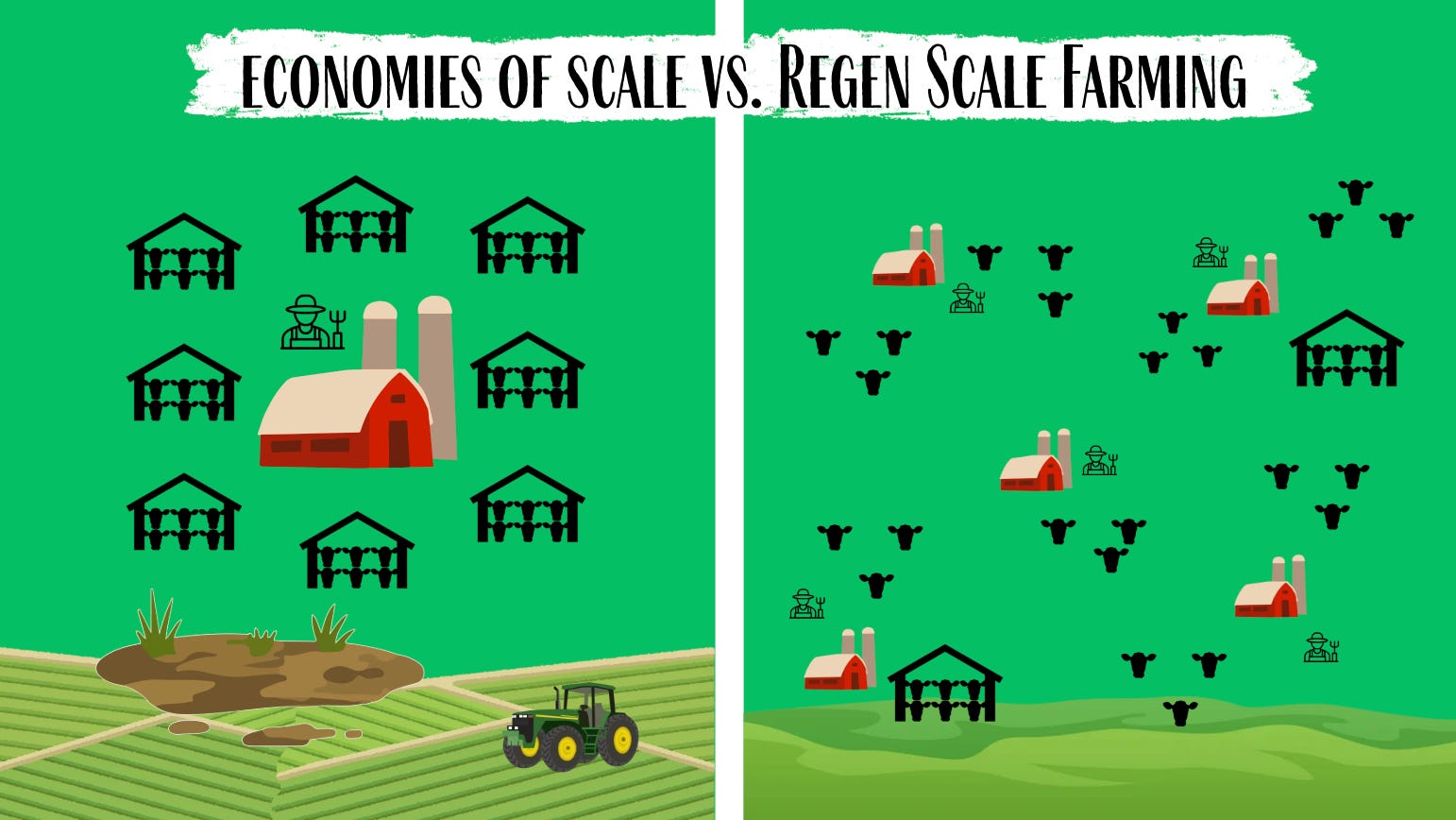
There’s something so simple and wonderful about this regenerative dairy vision. Doesn’t it seem like it’ll be better for literally everyone involved, the soil, plants, animals, workers, and neighbors, to have cows graze pasture in between milkings, rather than stand around inside, hoof-deep in their own stinking filth, for their whole lives just waiting to be milked? (“Smells like money,” farmers like to say, well, tell that to nearby property values.) And without a doubt this farm setup would absolutely yield regenerative outcomes (not just regenerative practices) as a grazed perennial pasture follows all the soil health principles..
And yet, rationally, there’s no way the 5,000 cow dairy I visited would ever consider transitioning to this alternative system, because doing so would cause their costs to skyrocket and a total breakdown of all the economies of scale they’ve worked so hard to achieve.
Here’s why: the goal of a dairy operating at this scale is, necessarily, to maximize the efficiency of every bit of capital, from the land to the milking equipment to the cows themselves, in order to drive the cost of producing a hundredweight of milk as close to zero as possible. To achieve that goal, you first want a single, centralized milking facility and the maximum number of cows that it can possibly service. That will allow you to milk cows nearly 24/7 and get the most out of your milking equipment. Then you want the most feed efficient cows money can buy, and you want them to be milked out 2-3 times a day to keep them as close to maximum milk output as possible. Then you optimize logistics. If you’re going to be moving 5,000 cows in and out of a single, huge milking facility multiple times a day, they all need to stay relatively close by, which also helps cuts down on the calories the cows spend walking to the milking parlor, which are calories they could be spending making milk instead. Speaking of calories, you want those girls eating non-stop and moving as little as possible (again, every calorie to milk possible), which means keeping them in barns, limiting their space to move around, and having their main (or only) enrichment activity be eating. Plus, when they’re eating a ration you’re bringing to them rather than one they pick themselves from a field, you can dial it in exactly to what will yield the most milk output without adding a single “unnecessary” nutrient. In other words, you can craft the soylent green of cow feed. The waste, the shit-slurry, then becomes is a manageable cost, the pumping, the ponds, and the stench are necessary evils in light of all the gains made by keeping tons of fine-tuned milk factories (cows) confined as close to the milking parlor as possible.
The critiques of our regenerative dairy alternative are then pretty obvious from the perspective of a 5,000 cow conventional operation. To feed 5,000 cows on pasture, I’d have to have cows walking a mile or more away from the milking parlor to find enough grass to eat every day. Every step she takes is less milk in my tanks. Plus, she still might not eat enough if she’s distracted by moving around, finding water, interacting with wildlife, or locating the forage she’s interested in, and that too will cut into her output. And who’s going to be moving all over my farm all day long, trying to herd grazing cows back to the central milking parlor 2-3 times a day. It’d take an army of field hands, when moving cows from confined barns to the parlor and back takes a mere handful. All of this quickly becomes an untenable recipe for reduced milk production, increased labor need, and my incredibly expensive milking infrastructure sitting idle. In other words, costs, costs, and more costs. This is the unfortunate reality of trying to get big farmers excited about a regenerative transition, when every signal they’ve received from nearly every source for most of their lives has told them, “capture economies of scale or die trying.”
But what if we gave up on trying to “pitch” farmers on regen ag, and decided to force a farm of this size to switch to our grass-fed regen dairy vision instead? Well, the farm would almost certainly fail. As the economies of scale disappeared and the unit costs rose, with no relief possible on the price size (milk is a commodity!), the farm would quickly collapse under the weight of its own immense scale. Even if the owners tried to downsize, to reduce the operation’s scale in order to adapt, the farm would probably not survive, because the infrastructure is too much of a drag to overcome. Consider that a single milking parlor with a 5,000 cow capacity is a huge, costly, and very permanent investment. The only way to cover its cost is to keep it working all the time, and the only way to keep it constantly operational is to have 5,000 milking cows close on hand.
Thinking about the impact of this milking parlor alone, and the pressure capital expenditure at this scale creates on a farm, offers clarity on why farms opt to do things like plant cover crops even when there’s little tangible outcome, rather than seeking to de-standardize their operations in pursuit of the genuine benefits of soil health. In large part, it’s because they literally can’t afford to do that. On the farm I visited, the money is already spent and their enormous assets are fixed. They’re on the “economies of scale” track, and there’s no turning around, not for fifty years at least, until they’ve realized the full return of their massive capital investment.
Takeaways
So where does this leave us?
I think we have to start by acknowledging that massive farms, capturing huge economies of scale as their competitive advantage, are probably not going to lead the way on regenerative agriculture. If for no other reason then because regenerative agriculture doesn’t create returns to scale. This is because achieving regenerative outcomes requires “knowing your context” and de-standardizing your farm, which runs directly counter to the kind of standardization required to realize economies of scale.
Notably, this doesn’t mean that it’s not possible to manage large areas, or even whole landscapes, regeneratively. It definitely is. It’s not the scale of the landscape, it’s the scale of the business that’s the problem. When a single farmer, or just a few farmers, are raising thousands of animals or thousands of acres of crops, they will, by necessity, have to more or less treat each of these unique plants, animals, and acres of soil as standard units, indistinguishable from any other and thus able to be, more or less, treated all the same way. All the cows get the same ration. All the acres get planted to the same crop. All the trees get sprayed with the same chemicals. All the pigs get treated with the same antibiotics. Regenerative ag rejects the idea that soils, plants, and animals can be reduced to standard units, and demands more careful and de-standardized care.
This will not be easy to achieve (or cheap), and there will be plenty of resistance to moving from existing massive scales to a scale of production more optimized to regeneration rather than to maximizing economies of scale. One first step, if we stick with the dairy example, would be move away from massive milking facilities (infrastructure investments), and encourage a move towards a lot more small, decentralized milking parlors that would allow cows to graze without traveling miles from a gigantic central facility. For a single farm that controls thousands of acres to make this transition would be madness– but it could make sense if some of these huge farms were split up and distributed across a larger group of people.
No matter how beautiful the future dream of regenerative ag is, today, our economy, politics, and to some extent, our whole society, is ruled not by dreams, but by profit. Our most tried-and-true method for profit-maximization is to capture economies of scale, and to continue to ratchet up the scale as long as the unit costs keep going down. As long as that paradigm remains unquestioned, I don’t think we’re going to see much in the way of progress on regenerative outcomes among farms operating at the largest scales.
There’s an old saying in agriculture— “the most valuable input on a farm is the farmer’s shadow.” This is another way to understand the idea of “knowing your context,” and it reveals something that we seem to have forgotten in our modern agrarian paradigm, dominated by small groups of people occupying huge swaths of land. That human presence and attention, on every inch of farmland, as often as possible, is a critical aspect of good farming. It also reveals why one of the most impactful ways to advance real regenerative ag transition is not by convincing huge farms to adopt regenerative practices, but finding ways to make huge farms smaller, making room for more farmers (and their shadows) on the land.
*A bushel is an irregular unit, but in general, it’s safe to assume it’s about 56 pounds.
Thank you for reading! I’m excited to hear all your feedback on this one. Also, new episode of Agribusiness Blueprint out now, all about answering the question, should you make the talent you need, or buy it?
Ooo Sarah. Get ready for a bunch of comments from startups in farm data, robotic milkers, invisible fence systems plus all the impact funds that sold VC model-type pay outs on the scheme of transitioning farms.
Totally in agreement. I would add that diversity is a central component of regenerative agriculture and it also doesn't marry with large scale for the reasons you mention, and also some additional reasons regarding markets and know-how. We have actually seen all this play out in organics over 50 years now and organic and regenerative are more or less the same - in principle.